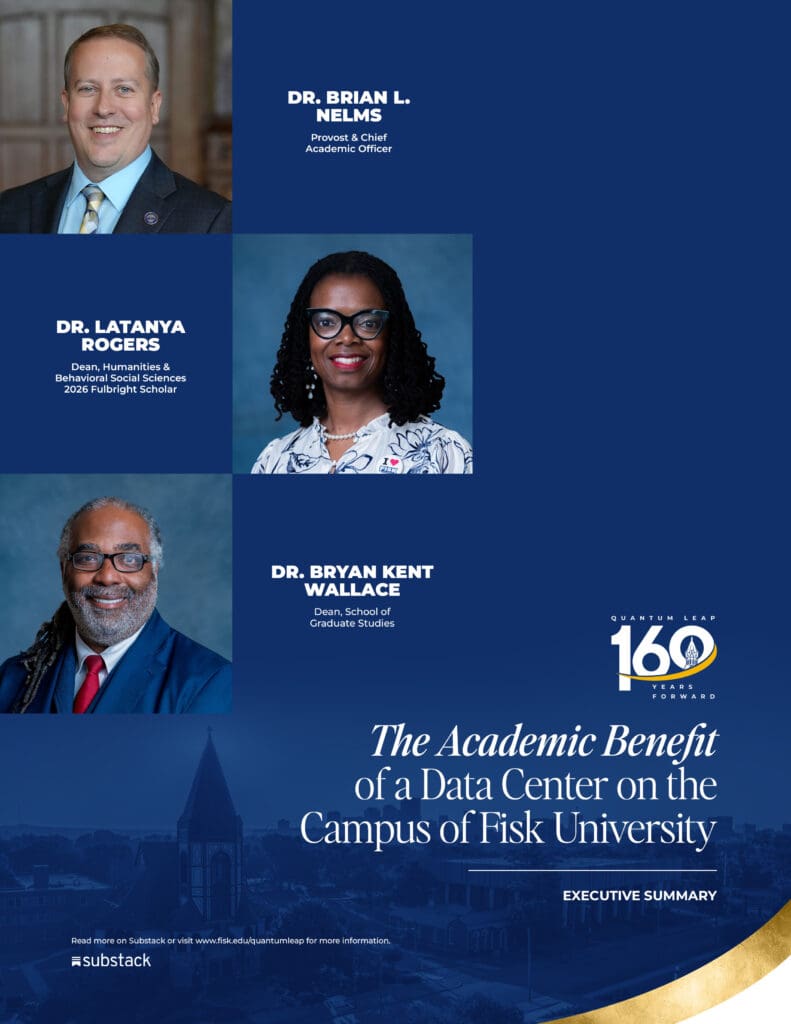
The Academic Benefit of a Data Center on the Campus of Fisk University
(Disclosure: no generative AI was used in the writing of this report)
EXECUTIVE SUMMARY
What is proposed: Fisk University will build a 100,000 square foot LEED-certified data center and academic hub at the south end of campus. The project will consist of a 30,000 square foot educational center and a 70,000 square foot, 30 megawatt (MW) data center co-located on a 5-acre site owned by Fisk University. The 30,000 square foot academic center will house state-of-the-art classrooms, data innovation computer labs, and tech- focused collaborative meeting spaces. This academic center will serve as a highly visible and active hub for tech initiatives across the university, providing a cutting-edge resource to students, faculty, and the community. The 70,000 square foot data center will be a partnership between Fisk University and a yet-to-be-determined corporate partner that will also share a commitment to community benefit and educational uplift. This data center will also host a supercomputer that will be controlled by the university to provide a resource for high performance computing as a research and educational tool for students and faculty. The project will be grounded in the principles of academic and community benefit and sustainability. The students, faculty, and staff of Fisk University can give voice to a humanistic implementation of technology and research grounded in critical thinking, justice, and the liberal arts that are part of our identity.
Why a data center, and why now? The prominence of big data and artificial intelligence across all fields is growing rapidly. This growth necessitates the development of flexible training and a continually-evolving curriculum to stay up to date with advances in the field so that students gain inspiration, discernment, and marketable skills, and faculty can leverage new technology in the advancement of discovery, knowledge, and societal impact. Importantly, in a tech-focused area, the University’s training and research goals will benefit from access to the latest technology, as the most attractive candidates for jobs and graduate/professional schools will be those that have already encountered and can confidently use these technologies, combined with the cognitive skills to adapt to change. Faculty and student research projects that leverage these tools will also give a competitive advantage in advancing knowledge, seeking grant proposals, and developing partnerships. Fisk has already been heavily involved in the areas of computing, data science, and AI, and has developed a strong foundation upon which to build. Our goal of creating the next generation of leaders and scholars will require staying ahead and at the forefront of these technologies. The proliferation of data centers, primarily to provide computing power and data storage for artificial intelligence and machine learning processes, is now the most prominent such advance. Fisk University can and has partnered with outside institutions and industry to try to give some students exposure, but to establish our own Data Center on campus will position Fisk University as a leader and allow Fisk to bring access to all students, removing some barriers and potential gatekeeping practices. Fisk University will also be in control to share the resource with community partners. Importantly, the data center and technical capabilities will initiate and propel important dialogue and training that intersects with the tradition of critical thinking and the liberal arts that will be woven throughout the fabric of new initiatives.
Why is it important for Fisk to be a leader in this area? As technology rushes forward, we are at an important juncture. The world will need leaders with the awareness and know-how of the latest technical developments combined with the cognitive skills to nimbly adapt and ethically solve complex problems. An increased focus on data and technology does not mean losing sight of Fisk’s liberal arts tradition. It may never be more important to lean into the core liberal arts foundation that has been at the root of Fisk’s mission to develop leaders and scholars. The core skills of critical thinking, creativity, communication, collaboration, and compassion emphasized at Fisk will inform the ethical and humanistic application of new technologies for social good for all. Placing this project at Fisk University also builds on a legacy affirming that HBCUs have always been centers of excellence, innovation, and leadership. It positions the project within an environment committed to expanding opportunity, cultivating diverse talent, and addressing the historic underrepresentation of Black scholars in fields that shape public knowledge, technology, policy, and culture.
How will it benefit Fisk students? The Fisk University Data Center will directly benefit students by greatly enhancing the university’s tech infrastructure, providing dedicated space for data science and computer science classes that does not currently exist, and direct hands-on access to relevant training through interactions with on-campus resources. The students will experience augmented degree program curricula, for both lecture and lab courses, as faculty can harness the power of on-campus access to high performance computing and data analytics. In addition, students will benefit from involvement in potential internships with the data center tenant and collaborating partners. By interacting with the data center tenant or a data center simulation lab in the academic hub, students can receive practical training in data center management, networking, and cybersecurity. An active Data Center on an HBCU campus will also center data science as a possible career path and showcase data scientists at Fisk, improving scientific identity among tech-focused students, and further awakening the integration of data competencies for students of all majors. Faculty will find it easier to integrate applications of data and AI across all disciplines, meaning all students at Fisk will have opportunities to discover how big data can intersect with their area(s) of interest.
How will it benefit Fisk faculty? The Fisk University Data Center will directly benefit faculty by providing teaching and research resources for faculty to integrate into their courses and scholarship. It will create a physical and virtual training and research environment. It will give access to high performance computing (via a supercomputer running on the data center servers) for advanced research methods across disciplines, and particularly in the areas of computer science, data science, mathematics, biology, physics, business, but also in emerging use cases in other areas such as social justice and digital humanities. Data-heavy and computational- heavy projects such as analysis of brain image data, molecular simulations, encryption for cybersecurity studies, natural language processing (NLP) and large language models (LLM) for modeling text and conversation will all be possible and accessible to our faculty researchers. The presence of the data center on campus will engender opportunities for professional development, through internal training and through collaborations with industry experts in using data centers. The Data Center will be an anchoring resource on campus, showcasing and highlighting for all our constituents the importance of data. It will provide real computing power to faculty, staff, students, and community partners. The physical space of the academic center will expand the portfolio of classroom and meeting spaces on campus, increasing our capacity. The inclusion of the Data Center and its associated capabilities will enhance Fisk’s reputation as a leader and assist in the recruitment of students, faculty, and collaborating partners to Fisk University.
How will it benefit the community? It is important to note that the proposed data center will be located in the North Nashville Qualified Opportunity Zone (QOZ, a designation by the U.S. Department of Treasury that contains lower income Census tracts). Unlike some other data centers that have generated controversy, with outside companies building data centers in lower income areas to exploit access to cheaper land and water and power usage, the Fisk University Data Center will be managed by the University on its own land, with over 150 years of experience and stewardship in the neighborhood. The tenant leasing the data center could bring economic growth to a community historically left out. The data center will create jobs, and there is the potential for the university to coordinate and/or promote job training for community residents. For a general public both increasingly curious and increasingly nervous about AI, the data center could serve a role as a data outreach and education coordinating center. It will become a hub for community conversations and action around inclusion of marginalized communities in AI/ML models and research into disparities, bias in data collection and analysis. Fisk University can become a leading voice in promoting equitable access to technology and for leveraging the power of technology to transform lives.
Are there any concerns about bringing a data center to campus? Data centers have been a potential source of controversy due to questions regarding sustainability, environmental impact on the communities where they are built, and ethical use and protection of data. The proposed Fisk University Data Center will not be on the same scale as the centers that have generated the most controversy. Fisk University has an opportunity to take a leading role in demonstrating the construction and use of a data center can be done in a way that is sensitive to community and environmental impact and mitigates the concerns typically associated with data centers (noise pollution, water usage, and power usage). The building will be a silver- or gold-level LEED certified building. New advances in cooling systems will allow for recirculating water, eliminating the need for massive water consumption. The edifice of the building will be similar to a neo-Victorian academic building in line with historic campus architecture and will limit noise. The center will be tapping into an existing 30MW power line under university property; through regular commercial power arrangements via NES/TVA, residential customers will not see any increases in rates nor reduced access to energy. These considerations will show that Fisk is not staking claim to something that is not ours or potentially exploiting or hurting the community. The example of a responsibly developed data center informed by best practices can provide a national or international model for how a community could benefit from a data center when it is designed from inside, providing access and education.
Read “The Academic Benefit of a Data Center on the Campus of Fisk University” whitepaper